Chapter 1: Ne Win’s Shadow
Yangon in the 1980s was a city of forgotten grandeur and faded hope, but to a child born into it, it was simply the world. The humid air hung thick with the smell of jasmine and vehicle exhaust, a constant presence that was as much a part of the city as the crumbling colonial buildings and the golden shimmer of the Shwedagon Pagoda. My world, however, was much smaller. It was the tight-knit streets of our neighborhood, the laughter echoing in the courtyard, and the quiet, urgent whispers of the adults.
I was born under the long, unyielding shadow of dictator Ne Win. The Burmese Socialist Party, or BSP, controlled everything. My parents, like everyone else, navigated a life of endless queues for rice, the sudden disappearances of neighbors, and the pervasive sense that every word spoken might be overheard. As a child, I didn’t understand the meaning of “one-party rule” or “socialist government.” The concepts were too abstract, too grand. The words I knew were simpler: “school,” “food,” “play.” The world of politics was a closed book, a collection of vague anxieties that flitted across my parents’ faces. I saw their fatigue, but I didn’t know the source. The world felt quiet, a stagnant pond where nothing ever seemed to change, yet the tension was always there, just beneath the surface.
Chapter 2: The 8888 Revolution
The silence didn’t last. One day, the whispers turned into a roar. I was in kindergarten, a time meant for learning simple songs and the alphabet, when the 8888 revolution began. I don’t remember the details like an adult would, but the fragmented memories are burned into my mind. I remember my late grandmother pulling me close, her face a mask of worry. I remember the sounds of shouting from the streets, the distant wail of sirens. The world outside the classroom, once a blur of safe routine, was now a violent, unpredictable storm.
The BSP government, once an unmovable fixture, collapsed. The man who had been a distant, frightening name—Ne Win—was gone. But the fear didn’t dissipate. Instead, it sharpened into something more defined, more immediate. The military junta took control, and the new face of power was Saw Maung. He was a stern, unsmiling figure who spoke of order and stability, but his promises felt hollow. The world outside the window of our home had changed completely, and though I was still too young to understand the complex power dynamics, I felt the new coldness that had settled over the country.
Chapter 3: Than Shwe’s Grip
Saw Maung was a temporary figure, a place-holder for a far more formidable mind. He was succeeded by Than Shwe, a man my parents spoke of in hushed, reverent tones of fear. “Cunning and a mastermind,” they would say, and for decades, he proved them right. He ruled with a chilling efficiency, a master of psychological warfare who knew how to twist a nation’s soul.
As I grew, so did my understanding. The political world was no longer a vague shadow; it was a cage. I saw how Than Shwe’s regime controlled every aspect of life. Information was a carefully filtered stream, and dissent was a death sentence. The city was under a constant watch, and the vibrant life I remembered from my childhood seemed to have been replaced by a pervasive sense of caution. This was the world of my youth, a reality shaped by a man who seemed to have no weaknesses, a man who saw everything and felt nothing.
Chapter 4: The Cruelest One
Now, the country is under the rule of Min Aung Hlaing. He is a different kind of dictator, cruel but also, as you said, “the most stupid one.” His brutality feels less calculated and more impulsive, a raw violence that is harder to predict. The decades of Than Shwe’s cunning have been replaced by a more direct, merciless force. It is a new chapter in the same old story, but the cruelty has reached a new peak, and the future feels more uncertain than ever before.
Chapter 5: A Different World
In Yangon, life was a series of improvisations. The most constant variable was the absence of electricity. Our days were dictated by the power schedule, a fickle, unpredictable thing that could disappear without warning for hours. Studying by candlelight became a normal ritual. The ever-present darkness after sunset was a blanket that settled over the city, a quiet reminder of how little control we had.
The world was not just dim; it was also tightly controlled. Foreign currency was a dangerous whisper, something you acquired and exchanged with the utmost secrecy, always with the understanding that you were being watched. A brand-new car was a phantom dream, an object of desire reserved only for those with ties to the military generals. For everyone else, it was a piece of the world they would never touch. And a cell phone, a small black brick of technology, was not just a convenience—it was a privilege, a symbol of immense wealth and influence.
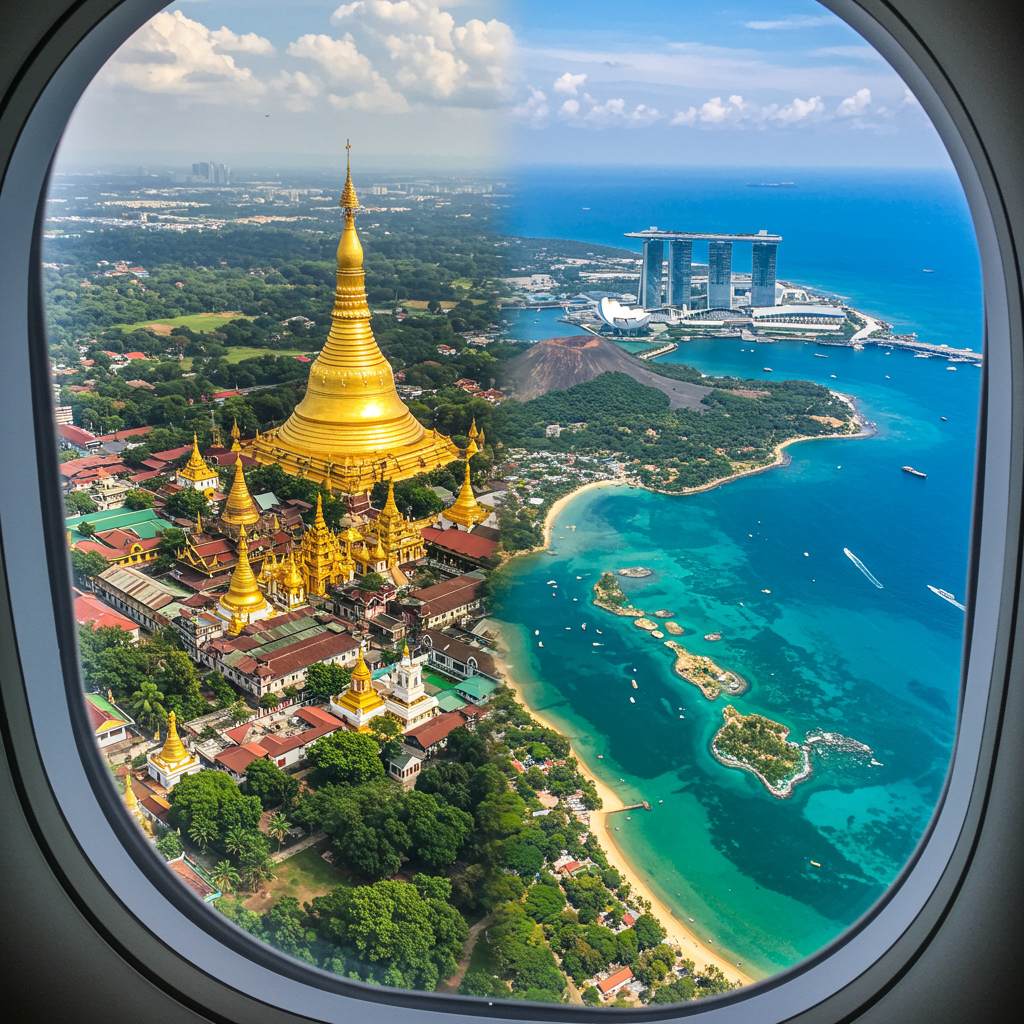
My first trip overseas, to Singapore, was a shock to my system. Stepping out of the airport felt like walking into a different reality. The air was cool and crisp with air conditioning, and the streetlights hummed with a reliable, continuous energy. The city was a monument to modernization, a world where the lights never went out. It was a place of impossible order and efficiency, a stark contrast to the beautiful, chaotic country I had left behind. While limitations still existed, and life wasn’t without its challenges, there was an undeniable sense that the government here cared for its people. It was a strange, disorienting feeling to see a city function so smoothly, to realize that the struggles I had taken for granted were not, in fact, the universal condition.
Chapter 6: Sand, Sea, and Salubrious Air
A decade passed in Singapore. The shock of my arrival slowly wore off, replaced by the quiet hum of a new routine. I learned to navigate the city’s clean streets and predictable systems, and the anxieties of my youth became distant, fading memories. Singapore was a safe harbor, a place to rebuild and breathe, but a part of me always felt like a guest, an outsider looking in. The order, while a comfort, sometimes felt like a cage of its own—neatly arranged and well-maintained, but a cage nonetheless.
So, after a decade, I left again. This time, my destination was an island of a different kind: Hawaii. I flew over the vast, shimmering Pacific Ocean, leaving behind the gleaming skyscrapers for something more elemental. The moment the plane descended, I felt the difference. The air that rushed in was warm and gentle, carrying the clean, wet scent of the sea mixed with the faint, floral sweetness of an unknown flower. It was “salubrious,” as you said, a word that felt too clinical for the feeling it inspired.
The sand was soft beneath my feet, the sea a hundred shades of blue, and the palm trees swayed with a casual grace that I had never seen before. The constant vigilance I had been taught as a child, and the rigid order I had grown accustomed to in Singapore, seemed to melt away in the face of such raw, untamed beauty. Here, the world felt open, not controlled. It was a place of vast horizons, and for the first time in my life, I started to believe that my own horizon could be just as vast.
 A New Latitude
Leave a comment