Chapter one:
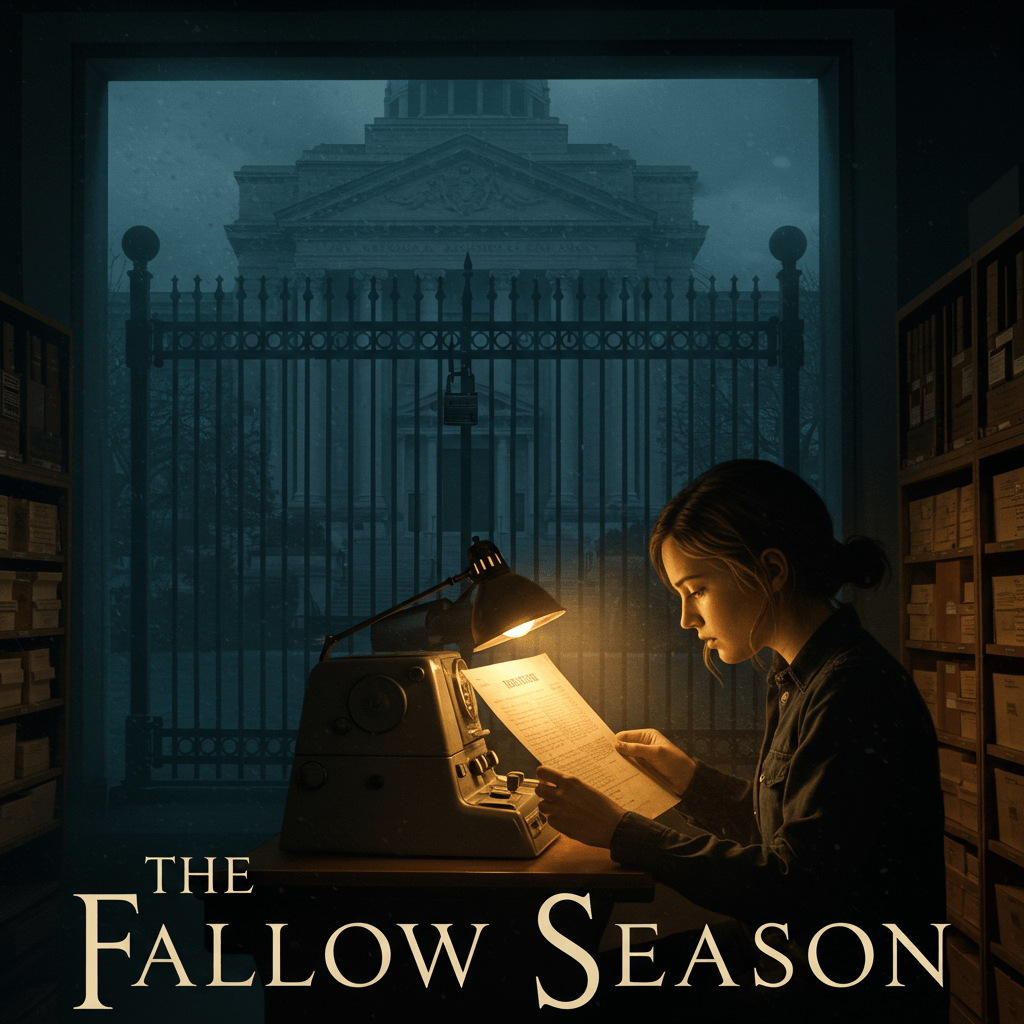
The locked door of the National Archives Annex was a mirror this morning. Elara didn’t see her own reflection, not really, just a distorted, gray smudge of a woman holding a lukewarm latte, framed by the wrought-iron fence. It wasn’t the institutional architecture that felt cold; it was the sheer bureaucratic silence.
The shutdown had begun with the usual political spectacle: a blustering headline, a quick, angry vote, and then the slow, creeping paralysis. For the first few days, the impact had been theoretical, a distant, televised annoyance. Elara, a freelance historical consultant specializing in early 20th-century municipal records, had joked about catching up on her reading. Now, two weeks in, the joke had curdled.
Her contract with the City Museum was dead in the water, drowning in the stagnant pool of inaccessible information. She needed the digitized building permits from 1904—data locked away on a server in this building, guarded by people who weren’t being paid to let her in.
She knew she was lucky. The ache in her bank account was a dull throb, not the sharp, existential panic of true hunger. She had savings. She wasn’t one of the security guards—people like Mr. Chen, whose quiet efficiency she had always admired, a man who clocked in every morning before dawn. She had seen him yesterday, standing outside the annex, not in uniform, just staring at the closed gates with a defeated slump to his shoulders.
She had tried to offer him coffee. “You shouldn’t be here, Mr. Chen,” she’d said.
He hadn’t looked at her, his eyes fixed on the empty guard booth. “Habit, Ms. Elara. And I check the news. Every day, I check. Hoping they’ve finished their nonsense.”
Nonsense. That was the word, simple and damning. The livelihoods of hundreds of thousands of people—the food on their tables, the heat in their homes, the medicine in their cabinets—were suspended over what both sides insisted was a matter of principle.
She thought of the archival documents she was trying to access. They detailed the construction of the old city hospital, a testament to a time when civic works, no matter how contentious, eventually got built. People argued, yes, but they ultimately laid bricks. They funded the project. They finished the roof. The work of the nation continued.
Now, it felt like the entire edifice was stuck in a perpetual disagreement over the color of the mortar.
Elara leaned against the fence, the cold metal seeping through her jacket. Her inability to work—the “significant effect” on her scope of work—was frustrating, but it was nothing compared to the quiet, dignified terror in Mr. Chen’s eyes. Her professional anxiety was a secondary effect; his was the direct, deliberate wound inflicted by the political class.
A pigeon landed on the sign listing the now-obsolete visitor hours. She finished her cooling coffee and crushed the cup, her anger a small, clean knot in her chest. She wished for a political miracle, a burst of sanity that would make both sides realize the real cost of their power struggle wasn’t measured in budget deficits, but in the lost wages of a security guard, the stalled careers of citizens, and the sheer, unforgivable waste of the country’s time.
The archives were closed, the city museum was waiting, and Elara had nothing to do but wish for the adults in the room to finally agree on the simplest, most essential thing: to work.
 A New Latitude
Leave a comment